HTTP API
Asks one address with a GET, or a POST of a fixed JSON body, every poll interval and reads what it answers as records.
Many services list their events or alerts at an address that answers a GET with JSON or lines of text, and some, such as Starlink's telemetry stream, answer a POST of what to send. This source polls such an address. A service that needs more than one request and its pages, such as Okta's System Log, has a source of its own.
Example
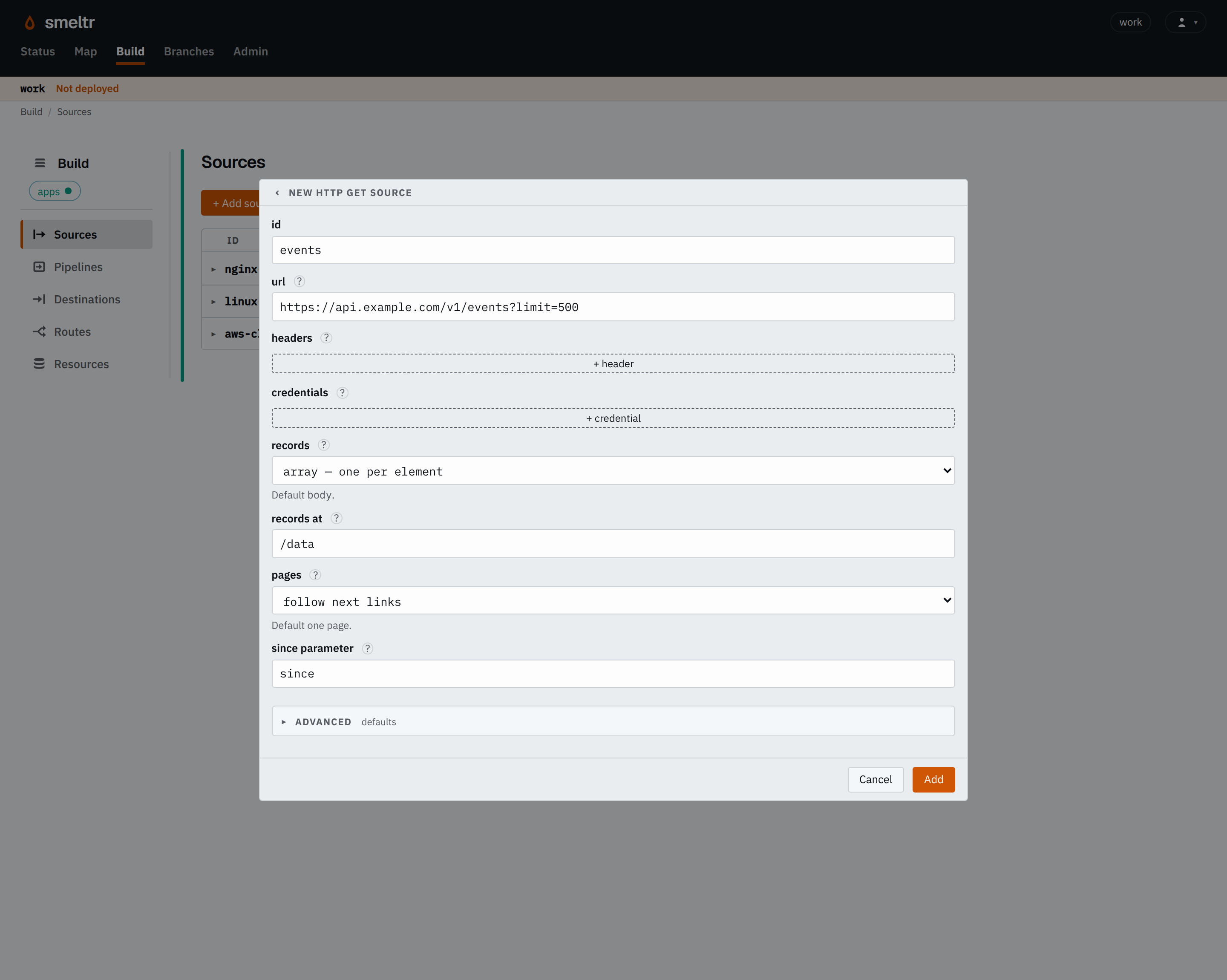
Asks api.example.com for its events every minute. The source sends the Authorization header from the worker-host variable API_TOKEN, reads
each element of the array at /data as one record, and follows the API's next links.
It asks only for what happened since its last poll, through the since query parameter.
{
  "id": "events",
  "type": "httpApi",
  "url": "https://api.example.com/v1/events?limit=500",
  "credentials": {
    "Authorization": "API_TOKEN"
  },
  "records": "array",
  "recordsAt": "/data",
  "followLinks": true,
  "sinceParam": "since"
}
Before you start
- Find the address that lists what you want, and check that a GET to it, or a POST of the body
it asks for, answers with JSON or lines of text. If the answer is a JSON object, note the JSON pointer to the array that holds the
records, such as
/data. - Find out how the API pages. This source follows a
Link: rel="next"header. An API that pages another way gives one page per poll. - Find the query parameter that asks for what happened since a time, if the API has one. Without it, every poll reads everything again.
- Put each secret header's whole value, such as
Bearer <token>, in a credential. - Allow workers to reach the address.
Settings
It also takes the settings every source takes.
url string required
The whole address it asks, http:// or https://, with any fixed query parameters. It sends a credential only over https://, or to this host.
https://api.example.com/v1/events?limit=500https://siem.example.com:8443/api/alertsmethod string default GET
How it asks.
GET- Asks with a GET.
POST- POSTs
bodyon every request, for an API that is asked by what it is sent.
body json default a POST of nothing
The JSON every POST carries, sent as application/json unless headers names a Content-Type. Only with method POST.
{"batchSize": 1000,"maxLingerMs": 15000}{"query": "status:open","limit": 500}credentials map default none
Headers whose values are secret, each name to the credential holding its whole value, such as Bearer <token>.
Authorization = API_TOKENX-Api-Key = VENDOR_API_KEYclientId string default none
The OAuth client it signs in as, with clientSecret or privateKey.
smeltr0oa1b2c3d4clientSecret credential default none
The credential holding the OAuth client's secret. Only with clientId.
API_CLIENT_SECRET{"secret": "api-client","version": 1}privateKey credential default none
The credential holding the client's RSA private key, PEM PKCS#8. Replaces clientSecret.
API_PRIVATE_KEY{"secret": "api-key","version": 1}tokenUrl string default none
Where the client's token is obtained. Replaces issuer.
https://auth.example.com/oauth2/tokenissuer string default none
The OpenID issuer, exactly as the provider writes it. Replaces tokenUrl.
https://login.example.com/realms/acmerecords string default body
Where an answer's records are.
body- Gives the whole answer as one record.
lines- Gives one record per line.
array- Gives one record per element of the JSON array at
recordsAt.
recordsAt string default the answer is the array
The JSON pointer to the array array reads, such as /data or /result/items. An answer with nothing there, or null, holds no records. Only with records array.
/data/result/itemsfollowLinks bool default false
Follows each answer's Link: rel="next" to the next page, within the same poll. A link to another host is refused, since the credentials go with every request.
sinceParam string default every poll reads everything
The query parameter that asks for what happened since a time. Each poll sends it the start of the last poll whose records every destination took, in RFC 3339 UTC, such as 2026-10-10T13:00:00.000Z.
sincestart_timeAdvanced
headers map default none
Headers it sends on every request, each name to its value. Smeltr sets Content-Length, Transfer-Encoding and Host itself.
Accept = application/jsonAccept = application/jsonX-Tenant = acmeidentity identity default none
The connection identity it connects under, for a private CA or a client certificate. Only on an https:// URL.
api-clientcorp-proxykeyId string default none
The kid naming privateKey, for a client with several keys.
k1scope string default none
The scope the client's token is asked for. Only with clientId.
read:eventsstart string default everything
What its first poll asks for.
everything- Asks without
sinceParam, for everything the API gives. new- Asks from the first poll's start. Needs
sinceParam.
sinceOverlapSecs integer default 0
Seconds before the last poll's start that sinceParam asks from, for an API that records events late. What falls in the overlap is read twice. Only with sinceParam.
30300pollIntervalSecs integer default 60
Seconds from the start of one poll to the start of the next. At least 1.
30060Fields it gives
Each record holds its text exactly as the API wrote it. __source.url holds the address
of the page the source read it from.
| Field | Type | Holds |
|---|---|---|
__source.name | str | The name of the source that read the record. |
__source.type | str | The kind of source that read it, its type, such as kafka, s3List, httpApi or hecReceiver. |
__source.url | str | The address of the page an API source read the record from. |
__source.bytes | bytes | The record's payload as the source read it, before any decoding. The source decodes _raw from it. A bytes destination writes it unless the destination names another field. Text functions refuse it; decode(__source.bytes, encoding) reads it as text. |
Where it starts
Without sinceParam, every poll asks for everything the API lists, so the source
delivers the same records again on every poll. Leave the sinceParam parameter out
of url; the source adds it whenever a poll asks from a time. A start of new needs sinceParam.
With sinceParam, the first poll asks for everything, or with start set
to new, for what happens from the first poll onward. Every later poll asks from the
start of the last poll every destination took, less sinceOverlapSecs. A restarted
worker resumes there, so it skips nothing. An API that records events late needs an overlap, and
the events in the overlap arrive twice.
How it works
One worker of the group holds the source, and the leader keeps how far it got. Each poll sends a
GET, or a POST of body, to url with the committed headers and the
credential headers. With followLinks, the source follows each answer's next link within the same poll, but
only to the same scheme, host and port, because the credentials go with every request. A page
that holds no records, or a link back to a page the poll already asked, ends the poll.
The source holds each answer whole, up to 256 MiB, and asks for the next page only once every record of the last one is handed on. It follows no redirects. Each request has 120 seconds to connect and read its whole answer. A request that runs longer, or an answer larger than 256 MiB, fails.
When the API answers 429 or 503, the source waits as long as its Retry-After asks, up to an hour. After any other failure it asks the same page again,
waiting one second at first and up to five minutes.
Verify
Find a record you know the API lists at the destination within a poll interval. On the Sources page, the worker column names the worker that holds the source.
Troubleshooting
The worker log shows what the API answered.
- Refused the credentials (401 or 403)
- Check that the credential holds the header's whole value, such as
Bearer <token>, and that the token may read the address. - Answered 301 or 302, give the address it leads to
- Set
urlto the address the log names. - The same records arrive on every poll
- Set
sinceParamto the API's query parameter for a start time, or accept that each poll reads everything. - Nothing arrives
- Check that
recordsmatches the answer, and witharraythatrecordsAtpoints at the array. An answer with nothing at the pointer holds no records.